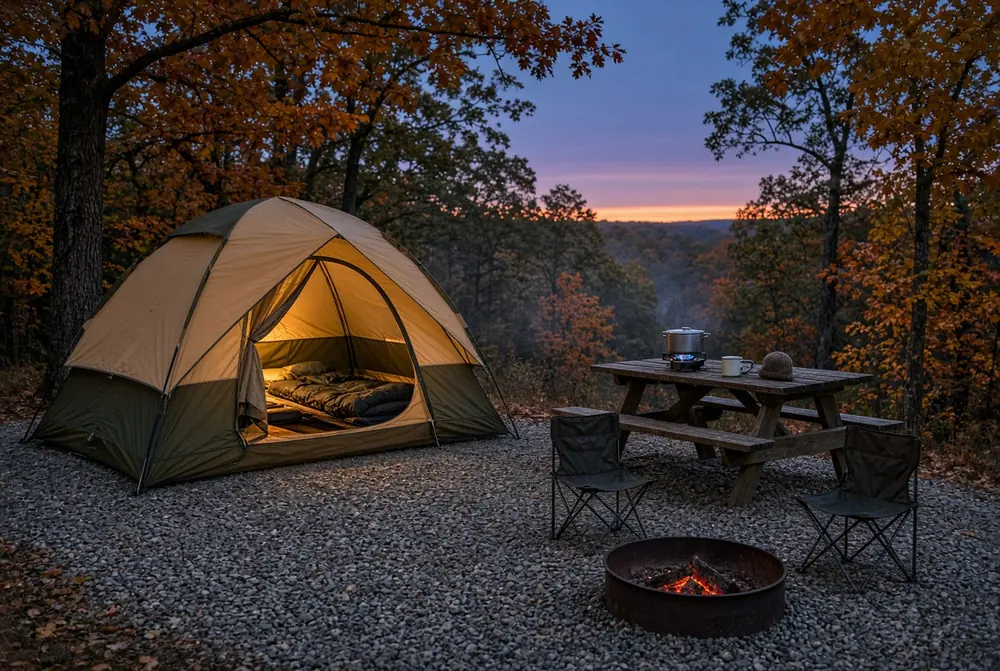
Labor Day does not end camping season in the Midwest. It changes the problem.
Days can still hit the 70s or 80s. Nights can drop into the 40s — and in low spots near a lake or river, into the 30s — while the calendar still says September. That swing is why fall trips feel harder than July trips. The tent that felt fine in July is the same tent. The air inside it is not.
This guide is for car campers and family campers planning September and October weekends in Missouri, Kansas, Iowa, Illinois, Arkansas, and nearby states. It covers when frost actually shows up, what to change in your sleep system, and which pieces of gear matter once the sun goes down.
If you already have a summer packing list, start with our late summer camping guide and then use this article as the cold-night add-on.
Why Midwest fall camping feels colder than the forecast
A phone forecast is usually the temperature at a nearby town, not the temperature at your picnic table.
Three things make a Midwest campsite colder than the app:
- Valleys collect cold air. River-bottom and lakeside loops at Missouri state parks often sit 5–10 degrees colder than the ridge above them after midnight.
- Clear, dry nights dump heat. After a cold front, skies go clear. The ground radiates heat straight up. Dew and frost form even when the official low is 38°F.
- You stop moving. Hiking generates heat. Sitting in a camp chair after dinner does not. The body cools fast once you are still.
Check the National Weather Service forecast for the overnight low and wind, not just the daytime high, before you leave. Use weather.gov and look at the hourly graph, not the seven-day cartoon.
For Missouri trips, pair that forecast with campground details from Missouri State Parks and our Camping in Missouri State Parks guide.
When the first frost usually arrives
These are averages, not a promise for one specific night in 2026.
- Northern Missouri and similar Upper Midwest latitudes: frost can show up in early to mid-October, and light frost is possible in late September in low ground.
- Kansas City metro, Columbia, Jefferson City, Springfield: the median first 32°F freeze often falls in late October.
- Southern Missouri and northern Arkansas: early November is more common, but river bottoms still surprise people in October.
Plan as if a 40°F night is possible any weekend after mid-September. If the forecast low is 45°F in town, pack as if camp will be closer to 38°F.
Fall color is a bonus, not the planning target. Peak color in Missouri usually runs mid-October into early November depending on the year. Book the campsite for the weather you can sleep in, then enjoy the color if it cooperates. Reserve state and federal sites early on Recreation.gov when you are crossing into national forest or Corps of Engineers campgrounds.
The sleep system beats the sleeping bag label
A “20-degree bag” is a lab rating, not a comfort guarantee. On a real Midwest night you have four layers under and around you:
- Ground insulation. Cold comes up through the tent floor. A sleeping pad with a higher R-value matters more than a heavier bag if you currently sleep on a thin foam pad.
- The bag or quilt. For September–October car camping, a bag rated 20°F to 30°F is the practical range for most people. Summer 40°F bags leave you awake at 2 a.m.
- What you wear in the bag. Dry base layers. Not the jeans you cooked in. Damp cotton holds cold.
- The tent microclimate. A closed rainfly traps a little warmth and blocks wind. Crack a vent so moisture does not soak the bag.
Browse sleeping bags and camp bedding as a system: bag + pad + liner. A liner adds roughly 5–15°F of comfort for almost no packed bulk and gives you a washable layer.
If you camp in higher country later in the season, use our mountain camping essentials article for elevation-specific changes. Midwest state-park loops are not the Rockies, but a 28°F night in the Ozarks still rewards the same sleep logic.
Do you need a different tent for fall?
Usually no. You need to use the tent differently.
A 3-season family or backpacking tent is enough for most Midwest fall weekends if you:
- Stake it tight so the fly does not flap and dump heat
- Keep the fly on after dark, even if the afternoon was warm
- Open roof vents or a window crack to cut condensation
- Keep wet boots and rain jackets in the vestibule, not on sleeping bags
A cabin-style family tent feels warmer because you can sit up and change clothes without crawling into cold nylon. A backpacking tent warms faster with one or two people inside because there is less air to heat. Choose by trip style, not by marketing season labels. Start with our tent buying guide and shop family and backpacking tents.
Skip cheap “4-season” labels on car-camping domes unless you are dealing with real snow load and high wind. For October in Missouri, ventilation plus a better sleep system beats a heavier tent.
Heat you can control without a fire ban problem
Fires are nice. They are not a sleep plan. Many parks restrict wood collection, and wet October wood does not heat a tent.
Use heat in this order:
- Hot water bottle in the foot of the bag. Boil water on a camp stove, fill a leak-proof bottle, wrap it in a sock. This is the highest-return trick on a 35°F night.
- A real cook system for hot meals. Warm food raises core temperature before bed. Cold sandwiches at 8 p.m. make the 2 a.m. wake-up more likely.
- Layered clothing, not one giant coat. Base layer, fleece, wind shell. Add a beanie. You lose a lot of heat through an uncovered head while sitting in a camp chair.
- Lanterns for light, not heat. A lantern or headlamp keeps you from stumbling, but LED light does not warm a tent. Do not run a grill or unvented heater inside a closed tent.
Keep a small first aid and safety kit accessible. Cold nights hide blisters, rolled ankles, and the kind of “I’ll deal with it in the morning” problems that get worse when fingers do not work.
A fall weekend packing list that is different from July
Keep the summer basics from our essential camping gear checklist. Then add or swap these:
Add
- 20–30°F sleeping bag or a liner for the summer bag
- Insulated sleeping pad
- Beanie, gloves, warm socks reserved for sleep only
- Extra stake kit and extra guy lines for fall wind
- Closed-cell foam sit pad for the chair
- Backup headlamp with fresh batteries (cold drains alkalines faster)
Leave or reduce
- Extra summer clothing that is all cotton
- The assumption that the fire ring will solve dinner
- Oversized coolers packed like a July picnic — you need less ice, more insulation for you
Follow Leave No Trace in crowded fall parks. Pack out food scraps, stay on established pads, and keep extra gear inside the site, not in the trees. The seven principles matter more in October because leaf cover hides trash and more people squeeze into the same loops for foliage weekends.
For hunting-season overlap in Missouri, check current dates and public-land rules with the Missouri Department of Conservation before you pick a conservation-area campsite.
How to pick a fall campsite that sleeps warmer
When you reserve or walk in:
- Avoid the lowest site next to standing water if a freeze is possible
- Prefer a site with a windbreak (trees on the north and west sides)
- Check whether the pad is in a frost pocket — if grass is already silver at 8 a.m. on arrival day, that loop will be the coldest
- Face the tent door away from the prevailing north wind
- Keep the car close enough that you can retreat to it if a kid is miserable at 1 a.m. That is not failure. That is why car camping exists.
National Park Service camping pages are useful even if you are staying at a state park. Their camping basics still apply: weather, water, wildlife, and a plan if conditions change.
Carry the Ten Essentials in fall the same way you would in summer. The difference is that “extra insulation” and “light” move up the list.
A simple overnight plan
Afternoon: Set the tent, rainfly on, pad inflated, bag unstuffed so loft can recover.
Dusk: Eat a hot meal. Change out of damp clothes.
Before bed: Boil water, fill the bottle, put tomorrow’s clothes inside the bag so they are not frozen-stiff.
Night: If you wake cold, add a layer. Do not wait until you are shivering.
Morning: Light the stove before you take the bag off. Hot coffee or cocoa is part of the system.
Fall camping in the Midwest is not a gear-buying contest. It is a timing problem. Pack for the night you will actually get — not the afternoon photo — and September and October stay in season.
FAQ
Is October too late to camp in Missouri?
No. October is one of the best months if you pack a real sleep system. Expect cold nights, not winter conditions, on most weekends.
Can I use a summer sleeping bag in the fall?
Yes, if you add a liner, an insulated pad, dry sleep clothes, and a hot-water bottle. If the forecast low is under 40°F and you already sleep cold, bring a 20–30°F bag.
Do I need a 4-season tent?
Not for typical Midwest state-park weekends. A taut 3-season tent with the fly on is enough until you are dealing with snow or alpine wind.
Where should I camp for fall color?
Ozark and southern Missouri parks often hold color a little later than northern counties. Book the site for weather and availability first. Color is a bonus.
Shop the setup: Tents · Sleeping bags · Camp stoves · Lanterns
Gear that matches this guide
- Sleep
- Lighting
- Kitchen
- USB Heated Envelope Sleeping Bag
- Kamperbox Ultralight Winter Sleeping Bag
- Heated Camping Chair