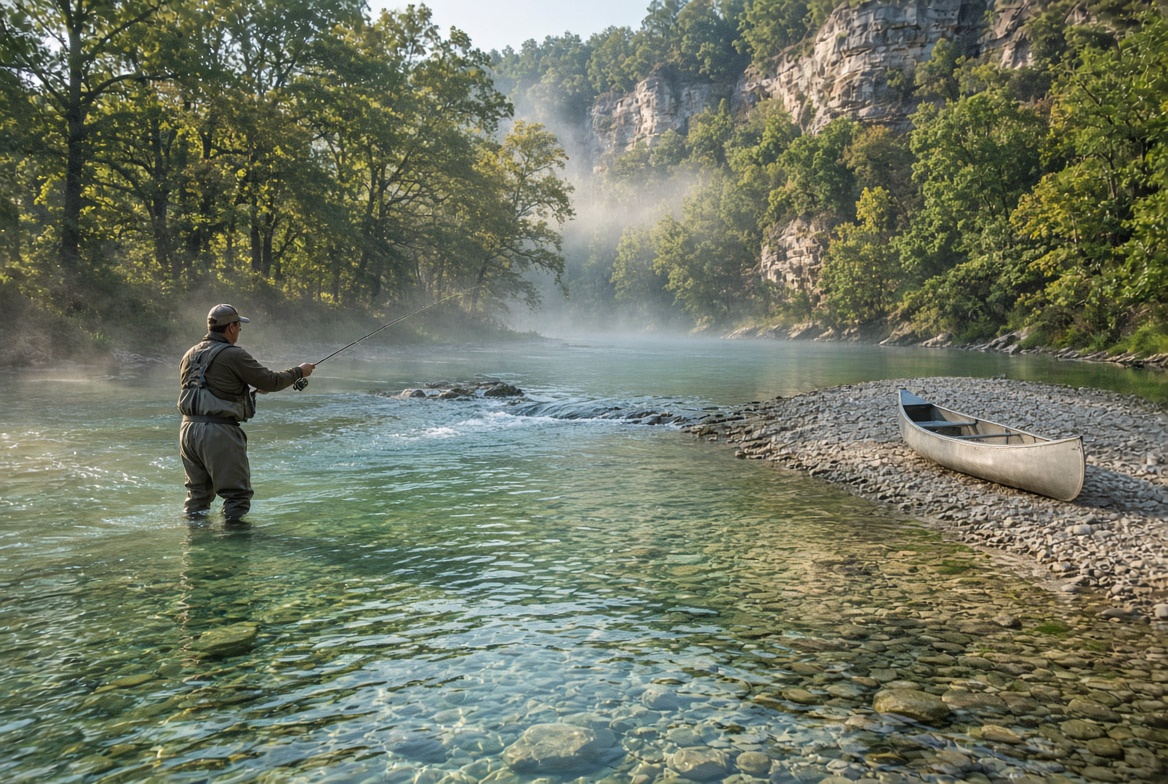
Missouri rivers are not scaled-down lakes. Current, gravel, springs, rootwads, and undercut bluffs decide where fish live. A good lake angler can have a blank day on the Current River by fishing the middle of a pretty pool instead of the seam where the riffle dumps in.
This guide covers two different kinds of water under one umbrella: Ozark moving water (Current and Jacks Fork, Meramec, Gasconade and Osage Fork, North Fork of the White, Eleven Point, Big Piney, Niangua, and a short note on the Bourbeuse) and the big-water Missouri, Osage, and Mississippi systems. The goal is a clear what-fish-where answer so “Missouri River fish species” searchers don’t mix the border river with Ozark smallmouth streams — and so float weekenders still get the riffle-run-pool read that actually puts fish in the net.
It also covers the permit and “ribbon” trout rules that trip visitors. Limits and segment rules change — confirm on MDC before you ice a fish.
Official starting points
- MDC fishing home
- Buy a Missouri fishing permit
- Special waterbody / fishing regulations
- 2026 fishing regulations summary (confirm the current year’s PDF on MDC)
- Ozark National Scenic Riverways (Current and Jacks Fork): National Park Service – Ozark National Scenic Riverways
Ozark stream black bass season for 2026 has been listed as May 23, 2026 through February 28, 2027. Outside that window, harvest rules change — catch-and-release or closed harvest may apply depending on the water. Non-Ozark streams and the big border rivers follow different calendars. Do not assume the lake bass season is the river bass season.
What fish are in the Missouri River? (big water — not Ozark streams)
When people ask what fish are in the Missouri River, they mean the big border river — not every stream inside Missouri. Typical big-water cast:
- Blue catfish — often the headline fish; heavy tackle, cut bait, and patience
- Flathead catfish — wing-dike holes, live bait, often after dark
- Channel catfish — widespread and willing when you put bait on the bottom
- Buffalo — common big-river rough fish
- Freshwater drum — hard fighters on cut bait or jigs near current breaks
- Skipjack herring — baitfish and light-tackle excitement near current seams
Species mix and harvest rules change by stretch and year. Frame it as boat fishing, often night, heavy tackle — not canoe-and-crayfish-crankbait gravel. This is not the Current River. Confirm seasons, limits, and methods on MDC fishing and the regulations summary.
Reciprocal agreements with Kansas, Nebraska, Illinois, Kentucky, Tennessee, Iowa, and Arkansas are in MDC’s reciprocal fishing privileges. Know which state’s water you are in; Missouri tributaries generally need a Missouri license.
Missouri River vs fishing rivers in Missouri
“Missouri River fishing” ≠ “fishing rivers in Missouri.” The Missouri River is the big border river — cats, buffalo, drum, skipjack, boat work. Rivers in Missouri also means Ozark streams (Current, Meramec, Gasconade) — smallmouth, goggle-eye, trout on ribbons, cats in pools. Looking for a float? Jump to Current/Meramec below. Looking for the border river? Stay here and use the big-rivers tactics half farther down.
How to read an Ozark river
Walk or float a mile and you will see the same four rooms, over and over:
- Riffle — broken water, oxygen, insect drift. Smallmouth hunt the tail.
- Run — faster, deeper slot along a gravel bar or bluff.
- Pool — slower, often deeper. Largemouth, goggle-eye, and catfish use wood and shade.
- Spring boil or tributary mouth — temperature refuge in July and January.
Fish the edges, not the postcard middle. A crayfish-colored crankbait ticking gravel at the head of a pool will out-fish a worm dumped in the still water nine days out of ten.
Ozark-stream black bass statewide language typically uses a combined daily limit of 6 with length limits that change by river segment. Several premier smallmouth stretches allow only one smallmouth in that six-fish bass limit and require 15 inches. Spotted bass sometimes have no minimum. That is why you measure before you ice a fish — and why you confirm the segment on MDC before the cooler comes out.
Current River and Jacks Fork: the showcase water
The Current is spring-fed, nationally designated, and easy to romanticize. It is also a real fishery: smallmouth, goggle-eye (rock bass), suckers, and — in designated stretches — trout.
Bottom line for Current River fishing: treat it as Ozark smallmouth and goggle-eye water with trout only where ribbon rules say so; Montauk State Park uses the trout-park tag system in season, and below the park you enter stricter river regulations. Summer Sundays are swimming parties — fish dawn, or pick a weekday. Confirm NPS access rules and MDC segment regs before you go.
MDC special rules on the Current have included:
- Walleye and sauger: 18-inch minimum on the mainstem and tributaries
- Blue Ribbon trout water on a defined stretch below Montauk (artificial lures and flies, 18-inch minimum, restrictive daily limit)
- Porous-soled wader ban in Dent, Texas, and Shannon counties (didymo / invasive-algae control)
- Trout in possession on length-limit waters must stay head, tail, and skin intact
Montauk State Park sits on the head of the system. Park fishing uses the trout-park tag system in season; below the park you enter river regulations that are stricter than a community lake. Park tag notes (recently $5 / $3) and winter catch-and-release hours live on MDC trout seasons.
Float-and-fish works if you treat the canoe as transportation, not a bass boat. Eddy out. Wade the tail of the riffle. Keep moving. The NPS Ozark National Scenic Riverways page covers access, gravel bars, and riverway rules that sit on top of state fishing law.
Jacks Fork is the Current’s sister: smaller, prettier in places, and excellent for smallmouth when flows are right.
Meramec River: the St. Louis angler’s home water
The Meramec runs from the Ozarks toward the Mississippi and passes close enough to St. Louis that you can fish after work. It holds smallmouth, spotted bass, largemouth, goggle-eye, channel and flathead catfish, drum, and redhorse.
MDC has a Smallmouth Bass Special Management Area from the Highway 8 bridge to the railroad crossing at Bird’s Nest: 15-inch minimum and only one smallmouth inside the black-bass bag. Flood years knock numbers around; the 2026 prospects language after late-2024 / spring-2025 flooding called the special-management stretch fair to good, with better mixed-bass fishing in the Crawford and Franklin county water.
How locals actually catch them:
- Crayfish crankbaits and compact jigs on current breaks
- Soft plastics around rootwads at the heads and tails of pools
- Live sunfish or nightcrawlers in deep holes for flatheads and channels
- Gigging season for suckers and other nongame fish has run September 15–February 15 on many streams — confirm in the current summary
Official write-up: Meramec River fishing prospects (MDC).
Maramec Spring Park (note the spelling) is a separate, privately managed spring campus on the system and has its own trout rules. Do not mix park rules with river rules.
Gasconade River and the Osage Fork: long, overlooked smallmouth water
The Gasconade is Missouri’s longest river that stays inside the state. It does not have the Current’s national-park traffic, which is the point.
On a defined Gasconade segment (Highway Y in Pulaski County to Highway D in Phelps County), MDC has used a 15-inch smallmouth minimum and only one smallmouth in the six-fish black-bass limit. The Osage Fork from Skyline Drive bridge near Orla to the Gasconade confluence uses the same idea.
Prospects language on the Osage Fork has described plenty of 12–15 inch smallmouth, goggle-eye in the 7–9 inch class around water willow and boulders, plus flatheads in the deeper pools. Crayfish crankbaits, compact jigs, and a simple Texas-rigged worm cover most of it. See Osage Fork prospects (MDC).
If you want a river that still feels like you found it, this is the one.
North Fork of the White and the Eleven Point
The North Fork of the White River is a trout-and-smallmouth river with Blue Ribbon water (Rainbow Spring to Patrick Bridge) and Red Ribbon water (Patrick Bridge toward Norfork Lake). Floods have hammered trout numbers compared with pre-2017 highs. MDC has been blunt: expect fewer trout, good body condition on the fish that remain, and lean on catch-and-release while stockings rebuild the population. Smallmouth in the 12–15 inch range remain a reliable backup.
Flies that still work: woolly buggers, Pat’s rubber legs, Prince nymphs, Adams, elk-hair caddis. Gear anglers do fine with tiny crankbaits and in-line spinners where the ribbon rules allow them.
Details: North Fork of the White River prospects (MDC) and the trout booklet / regulations on MDC.
The Eleven Point is another spring-fed, federally recognized river with rainbow stockings on designated ribbon water and wilderness-adjacent access. Flows and clarity swing hard after rain. Check generation-free, rain-driven levels before you drag a jetboat plan onto a river that wants a canoe.
Niangua, Big Piney, and the park-adjacent streams
The Niangua below Bennett Spring is a mixed trout-and-warmwater river with its own wader restrictions in Dallas and Laclede counties. Big Piney is a smallmouth river with gravel bars and enough gradient to keep fish honest. These are excellent “second rivers” if the Current is blown out or parking lots are full.
Bourbeuse River (short note)
The Bourbeuse is a Meramec-system warmwater stream — not Ozark postcard current, and not a full chapter here. Per MDC 2026 Bourbeuse prospects, black bass fishing should be good on most stretches; spotted/Kentucky bass are abundant on the Franklin County water, with a liberal daily limit of 12 and no length limit on that page’s language. Channel cats look fair; flatheads are less abundant. Suckers support gigging when the river is low and clear enough to see; crappie can be fair in deep, slow pools with wood. Use public MDC accesses, confirm methods and season dates on MDC, and do not invent “secret” float intel from a blog.
Big rivers: Osage, Missouri, and Mississippi — boat and heavy-tackle half
Not every Missouri river is an Ozark postcard. The species list for the Missouri River proper lives in the section above; this half is about how the big systems fish.
- Osage River below the Lake of the Ozarks / Bagnell Dam complex is catfish, white bass, paddlefish (highly regulated), and hybrid striped bass water. There is a no-fishing zone immediately below Bagnell Dam except limited live-bait methods. Paddlefish snagging is its own season and permit world — read the summary; do not improvise.
- Missouri River fishing means boats, current, and often night work: cut bait and heavy rods for blues, live bait for flatheads in wing-dike holes, bottom presentations for channels and drum. Plan for wind, barges, and long runs between safe ramps. Confirm reciprocal privileges if you straddle a state line.
- Mississippi River is the big-water cousin — similar catfish-and-rough-fish energy, different ramps and reciprocal partners. Same rule: know which state’s water you are in.
Osage, Missouri, and Mississippi are the same kind of fishing — big water, often boat-dependent — not the same as a Current River float. Bring stout gear from rods, reels & tackle if you are chasing blues, not the light spinning outfit you use for 12-inch smallmouth.
Trout ribbon water, in plain language
Missouri labels stream trout water as Blue Ribbon, Red Ribbon, or White Ribbon. The label is not decoration.
- Blue Ribbon: usually flies and artificial lures only, high minimum length (often 18 inches), very small daily limit (often 1). Built for trophy catch-and-release density.
- Red Ribbon: mixed tackle in many cases, 15-inch class minimums on browns or all trout, modest harvest.
- White Ribbon / trout areas: more harvest-oriented stockings, statewide-style limits unless posted.
A trout permit is required to possess trout on most waters. Trout parks use a daily tag in the regular season instead. Taneycomo above Highway 65 is a special case (trout permit to fish for any species). When in doubt, open the trout seasons page.
A river weekend that does not fall apart
Friday evening: Check USGS gauges and MDC area pages. If the Current is high and chocolate, shift to the Gasconade or a lower Meramec pool.
Saturday: Wade a special-management smallmouth stretch. Measure every bass. Keep sunfish for supper if you want fish in the pan; release the 14-inch smallmouth that would have been a “maybe” on a lake.
Sunday: Fish a ribbon trout tailout at first light, then a catfish hole in the first long pool below a riffle with a nightcrawler under a slip sinker.
Access, safety, and courtesy
- Public access does not mean the adjacent field is public. Use MDC and NPS accesses.
- Summer Sunday floats on the Current are swimming parties. Fish at dawn or pick a weekday.
- Wear a PFD in a canoe. Ozark rivers are shallow until they are not.
- Felt-free boots where porous soles are banned.
- Gigging, snagging, trotlines, and limb lines are legal in many places and illegal in others. The method that worked on the Missouri River can be a ticket on a trout ribbon.
- Packable lake inflatables stay on calm lakes. Do not put a Go Boats–style raft on Ozark current or whitewater as a default. For floats, use a canoe or kayak — see kayak camping Midwest lakes & rivers. For calm reservoirs and slow coves only, browse Go Boats.
Fishing Missouri Rivers FAQ
What fish are in the Missouri River (the big border river)?
Blue catfish, flathead, channel cat, buffalo, drum, and skipjack. Boat fishing, heavy tackle, often night. Confirm harvest rules on MDC. Not Ozark smallmouth water — not the Current River.
Is “Missouri River fishing” the same as fishing Ozark rivers in Missouri?
No. The Missouri River is the big border river. Ozark rivers (Current, Meramec, Gasconade) are riffle-run-pool smallmouth and trout-ribbon fisheries. Pack for the water you mean.
What fish are in Ozark streams like the Current, Meramec, and Gasconade?
Smallmouth, goggle-eye, spotted/largemouth in slower water, trout on designated ribbons, and channel or flathead in deeper pools. Measure bass — segment limits are real. Confirm on MDC.
What about fishing the Current River?
Everyday fishery: smallmouth and goggle-eye; trout only on designated stretches (Blue Ribbon below Montauk). Montauk uses the trout-park tag in season; below the park, river regs apply. NPS rules sit on top of state law; porous soles banned in Dent, Texas, and Shannon counties. Summer Sundays are crowded — fish early.
What about the Bourbeuse River?
Warmwater Meramec-system stream. MDC 2026 Bourbeuse prospects: black bass good; Franklin County spotted/Kentucky abundant (liberal daily limit of 12 / no length limit per that page); channel cats fair; flatheads less abundant; suckers for gigging; crappie fair in deep pools.
Blue vs Red vs White Ribbon trout — plain language?
Blue: usually artificial-only, high length minimum, tiny daily limit. Red: often mixed tackle, modest harvest. White / trout areas: more harvest-oriented unless posted. Trout permit outside parks; parks use a daily tag in season. See trout seasons.
Osage / Mississippi vs Missouri River — same kind of fishing?
Same kind: big water, boat-friendly, catfish-heavy. Osage below Bagnell adds paddlefish/snagging rules and a no-fishing-zone note — read the summary. None are Current River floats.
Can I use a packable inflatable (Go Boats) on Ozark current?
No as a default. Calm lakes / slow water only — Go Boats. Ozark current wants canoe, kayak, or a wade plan (kayak camping guide).
What gear for a Missouri river weekend vs a lake bank day?
Ozark streams: light-to-medium spinning or fly, crayfish crankbaits, compact jigs. Big Missouri River: heavy rods, stout line, cut or live bait. Soft path: rods, reels & tackle. Lakes: Missouri lake fishing combo.
Where do I check permits, seasons, and segment rules?
MDC fishing, permits, regulations. Current/Jacks Fork: NPS Ozark National Scenic Riverways. Outlooks: MDC fishing prospects.
Bottom line
Lake fishing in Missouri is about structure you can graph. River fishing is about current you can see. Learn one riffle-pool-run sequence on the Meramec or Gasconade, then take that same read to the Current. Keep the big Missouri River in its own mental folder — cats and heavy tackle, not Ozark smallmouth. Buy the right permit, read the segment-specific smallmouth rule, and treat ribbon trout water like the special regulation it is.
For reservoir tactics, docks, and bank/tube/boat framing, use the Missouri lake fishing combo guide (the best live lakes companion until a dedicated lakes-tactics page exists). The best Ozarks week is often one lake day and two river days — not the other way around.
Soft shop path when the trip plan is clear: rods, reels & tackle for weekend kits; Go Boats for calm lakes only; fish a Missouri state park without a trailer for bank/tube weekends; dawn/dusk light from lanterns & power. Questions — email campinglifeusa1@gmail.com. More about who runs the shop on About Us.
