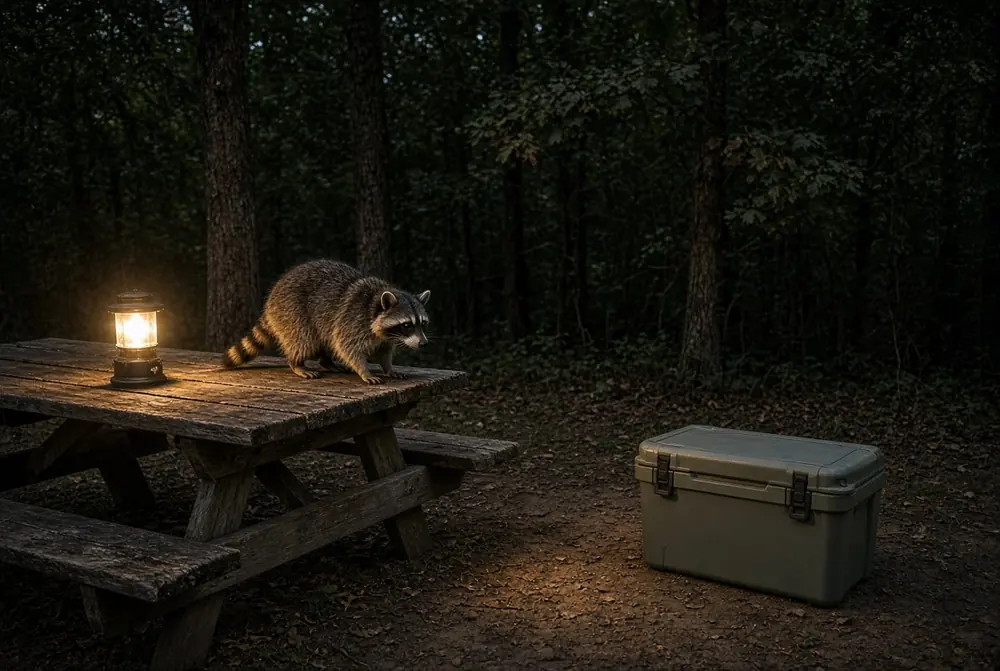
Keep raccoons and mice out of camp food by splitting camp into three zones: sleep, kitchen, and trash. Latch the cooler every time you walk away, keep wrappers and food smells out of the tent, get trash into the dumpster or locked in the vehicle before dark, and clean fish well away from camp.
The raccoon does not need a wilderness permit. It already lives in the loop. If you have ever woken up to a cooler on its side and a trail of hot-dog water across the pad, you already know the lesson: camp food storage is a layout problem, not a wildlife documentary.
This is not a bear-canister essay for the high country. It is a working guide for Missouri, Illinois, Arkansas, and nearby state parks where the usual thieves are raccoons, mice, squirrels, and the occasional campground dog. The goal is to keep food uneaten and gear unchewed without turning dinner into a military drill.
What actually gets into your stuff
Raccoons open latches you thought were clever. They climb picnic tables. They treat a loose cooler lid like an invitation. Mice go after crumbs in the tent vestibule and the smell on a stuff sack. Squirrels chew webbing and dry bags if salt or food residue is on them.
People make it easy:
- Cooking next to the tent door so the fly smells like bacon overnight
- Leaving the cooler “just for a minute” while everyone walks to the lake
- Storing snacks in the same tote as headlamps and clothes
- Tossing leftovers in a bag under the table “until morning”
Split camp into three zones
Give food a zone, sleep a zone, and trash a zone. Ten extra steps between the kitchen and the tent is worth more than any slogan on a cooler.
Sleep zone: tent, pads, bags, clothes. No wrappers. No toothpaste if you can help it. No leftover foil.
Kitchen zone: table, stove, cookware, the cooler that is actually closed. Cook here. Eat here. Wipe the table before dark.
Trash zone: sealed bag in the park dumpster or a hard-sided bin in the vehicle. Do not leave a tied grocery bag under the bench. That bag is a piñata.
Coolers only work if they stay shut
A soft pack on the ground is a snack tray. Use a hard cooler or a leakproof backpack cooler, set it where you can see it, and latch it every time you walk away. If the campground has a raccoon problem — most lakeside loops do — strap the lid or park the cooler in the vehicle overnight.
A leakproof cooler backpack is useful for day hikes and boat ramps because it stays closed while you move. Browse backpacks and bags for options that latch or zip all the way.
Do not store the cooler against the tent wall. A determined raccoon will work the seam. A mouse only needs a zipper gap.
Keep smell off the sleeping kit
Change out of the shirt you cooked in before you get in the bag. Wipe knives and cutting boards instead of leaving them “to soak.” Store camp cookware and knives in the kitchen tote, not in the vestibule with your shoes.
If you catch fish, clean them at the designated station or well away from camp, then get the carcass into a sealed bag and into the dumpster the same hour. A stringer under the picnic table teaches every raccoon in the loop your site number.
Chairs, pockets, and the food you forget you have
Trail mix in a chair pocket is still food. So is the granola bar in a jacket you draped over the guy line. Empty pockets at dusk the same way you latch the cooler.
Comfort gear still belongs in camp — just not as a pantry. Keep camping chairs in the kitchen or fire-ring area. A rocking chair with a cooler pouch is fine during the day. Empty it before you go to bed.
Light helps you catch the problem early
Most raids happen after the last person sits down and the lantern goes off. A low light on the table lets you see a lid that is not seated and a bag that walked two feet.
Leave a dim camping lantern on the table until everyone is in the tent. You do not need a floodlight. You need to notice motion.
If something already got in
Do not chase a raccoon with a stick. Make noise from a distance, let it leave, then clean every wrapper before you go back to sleep. Toss compromised food. Wipe the table. Check the tent door for crumbs. A half-clean site is a second invitation.
Keep a first aid kit handy. Food fights with wildlife are how people get bitten or cut on a can lid at 1 a.m.
A one-page food-storage routine
- Cook and eat at the table, not on the tent pad
- Latch the cooler every time you stand up
- Trash in the dumpster or locked in the vehicle before dark
- No wrappers, foil, or toothpaste in the vestibule
- Fish waste gone the same hour you clean the fish
- Empty chair pockets and jacket pockets at dusk
You will not outsmart every raccoon in a Missouri state park. You can stop being the easiest site on the loop. Close the cooler, move the smell away from the tent, and treat leftovers like trash the minute dinner ends.
Related: Camping + fishing lakeside getaway · Camp kitchen setup · How to turn your campsite into a fishing hub
Quick questions
What animals get into camp food at Missouri state parks?
Usually raccoons, mice, squirrels, and the occasional campground dog. Raccoons open latches and climb picnic tables, mice go after crumbs in the vestibule and the smell on a stuff sack, and squirrels chew webbing.
Where should the cooler go at night?
Not against the tent wall. Use a hard cooler or a leakproof backpack cooler and latch it every time you walk away. If the campground has a raccoon problem, strap the lid or park the cooler in the vehicle overnight.
What should I do with fish waste at camp?
Clean fish at the designated station or well away from camp, then get the carcass into a sealed bag and into the dumpster the same hour.
What if a raccoon already got into our food?
Do not chase it with a stick. Make noise from a distance, let it leave, then toss compromised food, clean every wrapper, wipe the table, and check the tent door for crumbs before you go back to sleep.