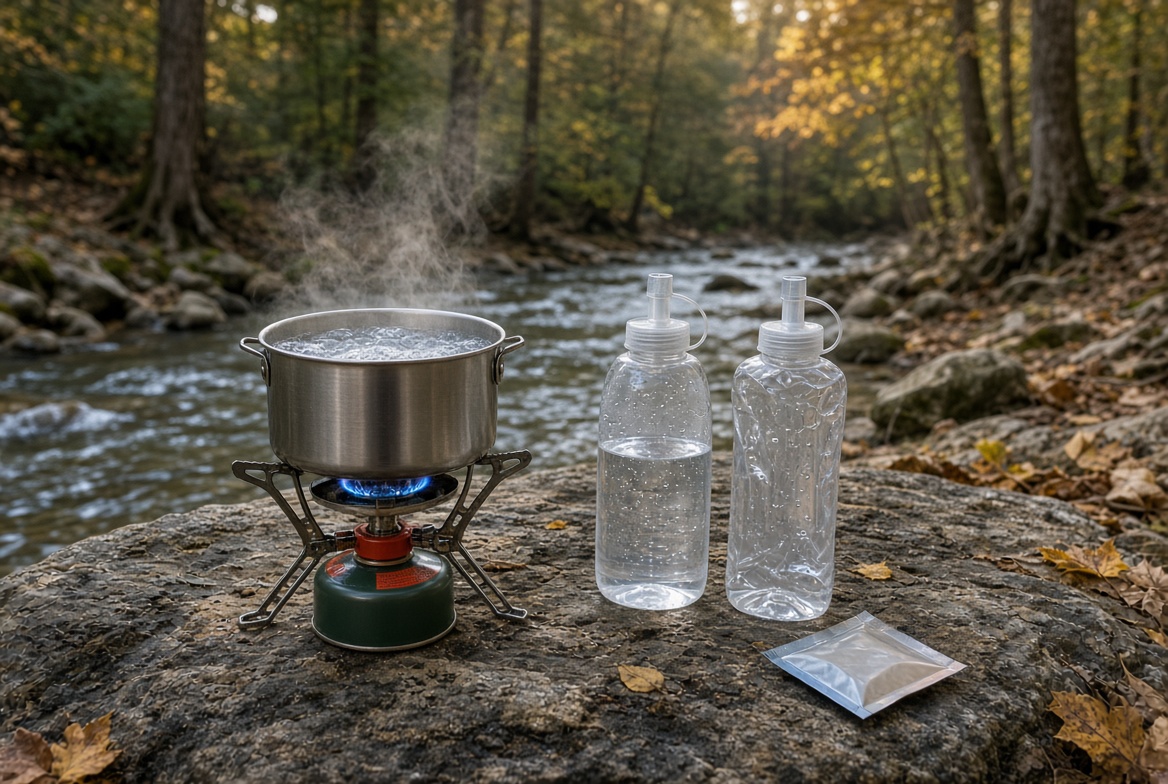
Clear water is not safe water.
A Missouri creek after a dry week can look perfect and still carry Giardia. A campground hydrant can be fine in June and posted “do not drink” after a main break in September. The mistake most campers make is picking one gadget — a filter bottle, a UV stick, a bottle of iodine — and treating it like a complete system.
The Centers for Disease Control and Prevention is blunt about the order: if you are not sure the water is safe, treat it. Boiling is the most reliable way to kill germs. If you cannot boil, filter first, then disinfect. That is the backbone of this guide. Read the CDC’s own page on water treatment for hiking, camping, and travel and the National Park Service note on two ways to purify water if you want the primary sources.
This article translates those rules into camp decisions: state-park spigot vs. creek, family car camp vs. short hike, and which hydration and filtration gear actually matches the job.
What is in untreated water
You are defending against three groups:
- Bacteria — E. coli, Campylobacter, Salmonella. A filter with an absolute pore size of 0.3 micron or smaller can remove these, according to CDC guidance.
- Parasites / protozoa — Giardia and Cryptosporidium. These are the classic “I drank from a pretty stream” illnesses. CDC says a filter needs an absolute pore size of 1 micron or smaller to remove them. Many camp filters advertise 0.1 or 0.2 micron, which covers this if the rating is absolute, not “nominal.”
- Viruses — norovirus, hepatitis A. Most hollow-fiber camp filters do not remove viruses. You need boiling, a true purifier, chemical disinfection after filtering, or a method the manufacturer rates for viruses.
Chemical tablets alone struggle with Crypto. That is why “just drop in iodine and wait” is incomplete if the water came from a lake with people and cattle upstream.
The method that always works: boiling
CDC and NPS agree: boiling is the best way to kill bacteria, viruses, and parasites.
How to do it
- If the water is cloudy, run it through a clean cloth, coffee filter, or the prefilter on your pump. Or let it settle and pour off the clear water.
- Bring it to a rolling boil for 1 minute.
- Above 6,500 feet, boil for 3 minutes.
- Let it cool. A pinch of salt per quart improves the flat taste.
You need a camp stove you trust and a pot from your cookware kit. If you already cook dinner on a burner, boiling breakfast water is not extra work. It is the same stove run.
Boiling does not remove dirt, heavy metals, or chemical runoff. It kills germs. For muddy ditch water, pre-filter, then boil.
Our camp kitchen setup guide and stove buying guide cover the hardware. Water treatment is why that stove earns a spot even on a “we’ll just make sandwiches” trip.
Filters: what they do and what they do not
A camping water filter is a strainer with a published pore size. Buy it for the hole size and the flow style, not the color of the bottle.
Common styles
- Squeeze / inline bottle filters. Fast for day hikes. Easy to pack. Limited volume for a family.
- Pump filters. Good at a creek when you need several liters. More moving parts.
- Gravity bags. Best for a group camp. Hang it, walk away, fill bottles.
- Bottle-with-filter. Convenient. Easy to skip cleaning. Flow slows when the cartridge loads up.
Rules that keep a filter honest
- Look for absolute micron rating, not marketing language.
- Check whether the product is a filter or a purifier. Purifiers are rated to handle viruses. Most $25 squeeze bottles are filters.
- After filtering creek water you will swallow later, add a disinfectant if viruses are a concern or if the source is downstream of a town, cattle, or a busy swimming hole. CDC’s line is filter, then disinfect.
- Backflush or clean on the schedule in the manual. A clogged filter gets used less, and “less” is how people start sipping untreated water.
Shop filters and bottles in hydration and filtration. Match capacity to the trip: one hiker can live on a squeeze bottle. A family of four at a dry campsite needs a gravity bag or a pot-and-stove plan.
Chemicals and UV: useful, with limits
Chlorine dioxide tablets
Better than old iodine against Giardia, and somewhat effective against Cryptosporidium. They still work best on water you already filtered. Follow the wait time on the packet. Cold water takes longer.
Iodine
Kills many bacteria and viruses. Weak on Crypto. CDC says do not use iodine if you are pregnant, have thyroid disease, or are sensitive to iodine, and no one should drink iodine-treated water for more than a few weeks.
Household bleach
Unscented regular bleach can disinfect in an emergency. Use current CDC emergency water instructions, not a memory of “a few drops.” See CDC emergency water guidance. This is a backup, not a taste anyone wants every weekend.
UV pens
They work in clear water. Turbid water hides organisms behind particles. Pre-filter cloudy water. Carry charged batteries. UV is a good second tool, not the only tool.
State park hydrants are not automatic
Many Missouri State Parks loops have marked potable water. Use it when it is posted as drinking water. Still watch for:
- Seasonal shutoffs after first freeze
- “Boil water” signs after repairs
- Shared spigots that pick up dirt from hose ends and pet bowls
If the post is unlabeled, treat it like surface water or ask the office. Our Missouri state parks camping guide is about choosing a site. This article is about what you drink once you are on it.
For beginners building a pack list, add water treatment next to the map and headlamp. It belongs with the Ten Essentials and the beginner hiking pack list.
How to choose water at the source
Leave No Trace asks you to protect water as well as drink it. Fill and wash 200 feet from lakes and streams when you can, and pack out soap. Read the Leave No Trace principles.
Better sources, in order:
- Marked potable campground water
- Fast, clear flowing water above obvious contamination
- Clear lake water taken away from the swimming beach and boat ramp
- Stagnant or muddy water — last resort, pre-filter + boil
Never drink untreated water just because local kids are swimming in it. Swimming and swallowing are different risks.
Keep a small safety kit that includes electrolytes. Waterborne illness plus a hot car ride home is how a weekend turns into a clinic visit.
A practical kit for two kinds of trips
Family car camp at a state park
- Confirm the hydrant is potable
- Carry a backup filter bottle
- Keep the stove ready to boil if the hydrant is off
Hike-in or dispersed camp
- Gravity or squeeze filter rated 0.2 micron absolute or better
- Chlorine dioxide tablets
- Stove and pot so you can boil if the filter cracks or freezes
- One extra bottle of already-treated water in the car or cache
Water treatment is not a single SKU. It is a short process you can still do when you are tired. Build it into the same checklist you use for shelter and light. The essential camping gear checklist should include “how we will drink,” not just “we brought bottles.”
Quick comparison
Method | Kills / removes | Weak against | Best use Rolling boil 1 min (3 min above 6,500 ft) | Bacteria, viruses, parasites | Chemicals, sediment | Any trip with a stove Filter 0.1–0.3 micron absolute | Bacteria, parasites | Viruses, many chemicals | Creeks and lakes, daily drinking Filter + chlorine dioxide | Broader coverage including viruses | Taste, wait time | Mixed or high-use water sources Iodine alone | Many bacteria and viruses | Crypto, long-term use, pregnancy | Short emergency only UV in clear water | Many germs if used correctly | Cloudy water, dead batteries | Fast clear-water backup
FAQ
Can I drink from a clear Ozark stream if I fill upstream of camp?
Treat it. Clarity does not remove Giardia. Filter, then boil or disinfect.
Is a filter bottle enough for a family weekend?
It is enough for hiking bottles. For cooking and four people, add a gravity system or plan to boil a pot at the stove.
Do I need to treat campground tap water?
If it is posted potable and the park has not issued a boil-water notice, you can drink it. When the post is unmarked or the system is shut down for the season, treat it.
What micron rating should I buy?
CDC: 0.3 micron or smaller for bacteria, 1 micron or smaller for parasites. A 0.1 or 0.2 micron absolute filter is the practical camp standard. Add disinfection if viruses matter at that source.
Shop the setup: Hydration & filtration · Camp stoves · Cookware · Safety kits
