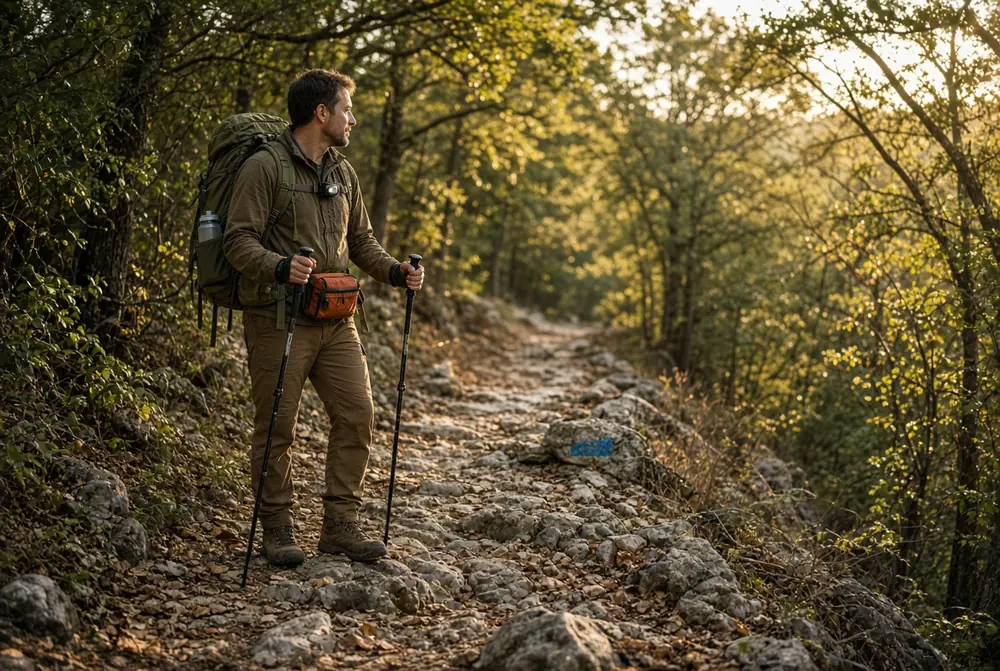
Most hiking articles start with a packing list. That is useful — we already covered the modern Ten Essentials on this site — but gear sitting in a pack does not keep you safe by itself. Safety on the trail is a series of small decisions: when to turn around, how fast to drink, whether that ridge is a good place to be in a thunderstorm, and whether your group is actually together.
This guide is about those decisions. It is written for day hikers and overnight hikers who already own basic gear and want fewer close calls. The focus is Midwest and Ozark-style hiking as much as mountain travel: heat, ticks, flash flooding in hollows, poorly marked junctions, and the habit of underestimating a “short” 6-mile loop.
How this article is different from our existing posts: The Ten Essentials article covers what to carry. Hiking for Beginners covers first-trail packing and easy mileage. Mountain Camping Essentials covers elevation, cold, and alpine weather. This post covers behavior on the trail — the habits that turn that gear into actual safety.
1. Safety starts before you leave the driveway
A surprising number of search-and-rescue calls begin with a plan that was never written down. Someone said “we’ll just do the loop” and nobody left a return time.
File a simple trip plan
You do not need a formal permit form for a state-park hike. You do need one person who is not on the trail to know:
- Where you are parking and which trailhead
- The planned route and a backup shorter route
- Who is in the group and any medical notes that matter
- When you expect to be back at the car
- When they should start calling (usually 1–2 hours after your return time)
If plans change on the trail, update that person when you have signal. A late text is better than a silent no-show.
Read the day, not just the forecast icon
A phone showing a sun symbol is not a plan. Check:
- High and low temperatures at trail elevation, not just the nearest town
- Chance of storms and the timing of the storm window
- Wind on ridgelines and heat index in open prairie or glade sections
- Recent rainfall if the route crosses creeks or follows a hollow
In Missouri and much of the Midwest, summer afternoons often build thunderstorms. Start earlier than feels necessary. A 7 a.m. start is not overkill in July; it is the difference between walking in shade and walking in 95-degree heat with lightning in the next county.
Match the hike to the weakest person that day
Fitness from last month does not count if someone slept four hours, is fighting allergies, or is breaking in new shoes. Choose mileage and elevation for the person who will struggle first — including you. Pride is a leading cause of late descents.
2. Navigation is a safety skill, not a gadget
Getting lost is rarely dramatic at first. It is usually a missed blaze, a social trail that looks official, or a junction where two worn paths look equally right.
Use two systems
Carry a downloaded offline map and a paper backup or at least a printed park map. Phone batteries die in the cold and in the heat. Know how to identify your last confirmed point, not just how to follow a blue dot.
A compact navigation and electronics kit belongs in the pack even on familiar loops. If you hike the same park every weekend, that is exactly when you stop paying attention.
Habits that prevent “we’ll just go a little farther”
- Confirm the junction before you leave it. Look back so you will recognize the return.
- Set a turnaround time, not only a destination. If you have not reached the overlook by 1:30, you turn around at 1:30.
- When the trail and the map disagree, stop. Do not keep walking while arguing.
- On unmarked or lightly blazed trails, take a photo of each major junction.
3. Water, heat, and the slow emergency
Dehydration and heat illness are the most common “I didn’t think it would happen to me” problems on Midwest trails. They do not feel like emergencies until they do.
Drink on a schedule, not when you feel thirsty
Thirst lags behind need, especially when you are talking or pushing a hill. A practical starting point for a warm day hike is about half a liter per hour, more in full sun or high humidity. That means you cannot start an 8-mile July hike with one 16-ounce bottle and a plan to “find a stream.”
Carry water you will actually drink. A tactical hydration pack keeps fluid on your back so you sip without stopping. Pair it with a 32-ounce hiking bottle in a side pocket for mixing electrolytes or sharing. Browse the full hydration and filtration category if you need a filter for longer routes.
Know the early signs
Stop and cool down if anyone has a pounding headache, stops sweating in high heat, becomes irritable or confused, or starts staggering. Move into shade, loosen layers, sip fluids, and be willing to abort the hike. Heat stroke is a 911 problem, not a “rest five minutes” problem.
Cooling tricks that work on trail: wet a bandana, sit on the downhill (usually cooler) side of a ridge, and take packs off so air reaches your back. Dark clothing in August is a choice you will regret.
4. Terrain hazards most people underestimate
You do not need a 14,000-foot peak to get hurt. Ankle injuries, slick limestone, and flooded crossings account for a large share of Midwest trail incidents.
Footing and poles
Loose gravel on a 12-percent grade is more dangerous than it looks. Trekking poles reduce load on knees on the descent and give you a third point of contact when rock is wet.
A folding pole with an alarm and light, such as the 5-level adjustable hiking stick with LED and alarm, is useful on late-day returns. A lighter travel folding trekking pole packs easily in a daypack. See the full trekking and hiking poles collection.
Water crossings and flash flooding
Ozark hollows and Midwest creek trails can rise fast after an upstream storm you never felt. If the water is moving faster than you can walk, is above mid-shin, or you cannot see the bottom, do not cross. Upstream storms are not visible from the crossing. Turn around. That is the entire protocol.
Ticks, plants, and “just a scratch”
Do a full tick check at the car, not “later at home.” Tuck pants into socks in tall grass. Carry a small removal tool in your first aid kit. Learn poison ivy before the season starts — “leaves of three” is still the most useful phrase on Missouri trails.
5. Wildlife: respect without panic
Most wildlife problems come from food handling and surprise encounters, not from animals hunting hikers.
- Make noise in brushy corners and on blind ridges. Conversation is enough in most Midwest woods.
- Do not approach fawns, turkey hens, or any animal with young.
- Hang or canister food on overnight trips. A “just this once” bag of jerky in the tent teaches raccoons and mice that tents are snack drawers.
- If you hike in bear country outside the Midwest, know the local carry and storage rules before you arrive. Do not improvise from a social media clip.
Snakes want the sunny rock more than they want you. Look before you sit. Give them the trail. Most bites happen when someone tries to move, photograph, or kill a snake.
6. Weather that changes the plan
Weather is the most common reason a reasonable hike becomes a rescue.
Thunderstorms
If you hear thunder, you are in range. Get off exposed ridges, open glades, and isolated tall trees. Descend into forest if you can do it quickly and safely. Metal poles can be set aside during the worst of a close storm; people are not lightning rods because they hold aluminum, but standing on a bald knob in a cell is still a bad idea.
Rain, hypothermia, and 60-degree days
Hypothermia is not only a winter event. A soaked cotton shirt, wind, and a long descent in the 50s will drop core temperature. Wear a layer that still insulates when wet, keep a dry spare in a waterproof pouch, and eat on a schedule. Shivering plus clumsy hands means you stop and fix the problem immediately.
A compact emergency blanket and survival layer weighs almost nothing and covers the “we misjudged the storm” case.
7. Group safety is a leadership problem
Solo hiking has obvious risks. Group hiking has different ones: the group stretches out, the fastest person makes the route decisions, and nobody wants to be the one who says they need to stop.
- Put the slowest person near the front, not dragging at the back out of sight.
- Regroup at every junction. “They’ll catch up” is how people take the wrong spur.
- Agree on a whistle or shout code before you start: three blasts means stop and answer.
- Kids and dogs are part of the group’s speed and water budget. Plan for both.
Keep a real first aid kit accessible, not buried. The Adventure Medical Ultralight/Watertight .9 is sized for a daypack. For family or group trips, a larger 420-piece survival first aid bag can live in the car with a slimmer kit on the trail. A MOLLE trauma pouch clips to a pack strap so it is not a 10-minute excavation.
8. Nightfall, getting stuck, and calling for help
The hike is not over at the overlook. Most problems happen on the way down, when people are tired, light is fading, and shortcuts look tempting.
Carry a headlamp even on a “we’ll be back by 3” hike. The rechargeable 6-mode headlamp leaves both hands free for poles and a map. A backup USB rechargeable flashlight belongs in a zip pocket. Shop lanterns, headlamps, and LED lights so you are not using a dying phone screen as a light.
When to call
Call early if someone cannot walk on their own, if you are off-route and cannot reorient, or if weather or darkness will strand you without shelter. Give dispatch your last confirmed location, the number of people, the injury, and what you can still do. Stay put once you have decided you need help, unless staying put puts you in immediate danger.
A small 14-in-1 emergency survival kit or 125-in-1 survival kit is not a substitute for a plan. It is a backup when the plan fails.
9. Tools that solve problems without becoming clutter
A knife or multitool earns its weight if you can cut moleskin, repair a strap, and open a stubborn package. See camping knives, axes, and multitools and a compact option like the multifunction tool pliers.
Fire is for warmth and signaling, not for every lunch stop. Keep a reliable starter from the outdoor lighters and fire starters collection in a dry bag, not loose in a hip belt where sweat kills it.
A practical trail-safety checklist
| Before you go | On the trail | If things slide |
|---|---|---|
| Trip plan + return time left with someone | Drink on a schedule | Stop while you still have options |
| Weather beyond the icon | Regroup at junctions | Treat heat and cold early |
| Water for the whole day + extra | Turnaround time is a rule | Use light before you need it |
| Headlamp + first aid accessible | Do not cross moving water you cannot read | Call with a last confirmed point |
| Footwear already broken in | Tick and plant awareness | Stay put after you call, if safe |
Gear to keep in the pack, not “in the car just in case”
Day-hike safety kit we actually use: a hydration pack or bottle, headlamp, ultralight first aid kit, trekking pole, multitool, and a small emergency layer. None of this replaces judgment. It gives judgment more time to work.
Final thought
Safe hiking is not dramatic. It is the unglamorous habit of leaving a note, turning around on time, drinking before you are thirsty, and treating a twisted ankle as a reason to shorten the day instead of a reason to prove something. The best hike is the one that ends at the car with enough energy left to plan the next one.
Shop trail-ready gear at Camping Life USA — start with essential camping and hiking equipment, safety and first aid, and backpacks.